DNA Is Not Enough
By C. D. Ford
Read at INWWM Education Day, “The Truth About All the Lies Being Spoken Of,” on Saturday 14 November 2026 at 202 Bentworth Avenue, Toronto (watch the recording on YouTube). Scripture quotations are from the King James Version, with references entered after each quotation.
There is a growing appetite for the name of Israel.
Videos circulate, test kits are ordered, results are celebrated, and the claim is made: even from the continent that sold us, their DNA is suddenly proving it.
Migration patterns are traced, ethnic groups are listed, false knowledge of where the twelve tribes now reside is being circulated, and the audience is invited to conclude that the question of Israelite identity has been settled in a laboratory, among ignoramuses.
It has not. And the scripture itself tells us why it cannot be.
They Are Not All the Chosen Israel
Before any laboratory existed, the scripture had already dismantled the entire DNA enterprise in a single sentence: “For they are not all Israel, which are of Israel” (Romans 9:6).
Read that carefully. If the scripture itself declares that not all who are of Israel are really Israel, then what exactly is a genetic marker supposed to prove? Markers can be found across nations. Claims can be multiplied across continents. But if Israel was never defined by bloodline alone, then bloodline alone can never define the chosen Israel.
The DNA argument was answered two thousand years before it was made.
This is the issue with DNA when it comes to all those nations and their claims. The scripture does not recognise every claimant. It never did.
The Signature of the Prophecy
The curses of Deuteronomy 28 are conditional, “if thou wilt not hearken unto the voice of the LORD thy God, to observe to do all his commandments and his statutes” (Deuteronomy 28:15), and among them stands a verse with the specificity of a historical photograph:
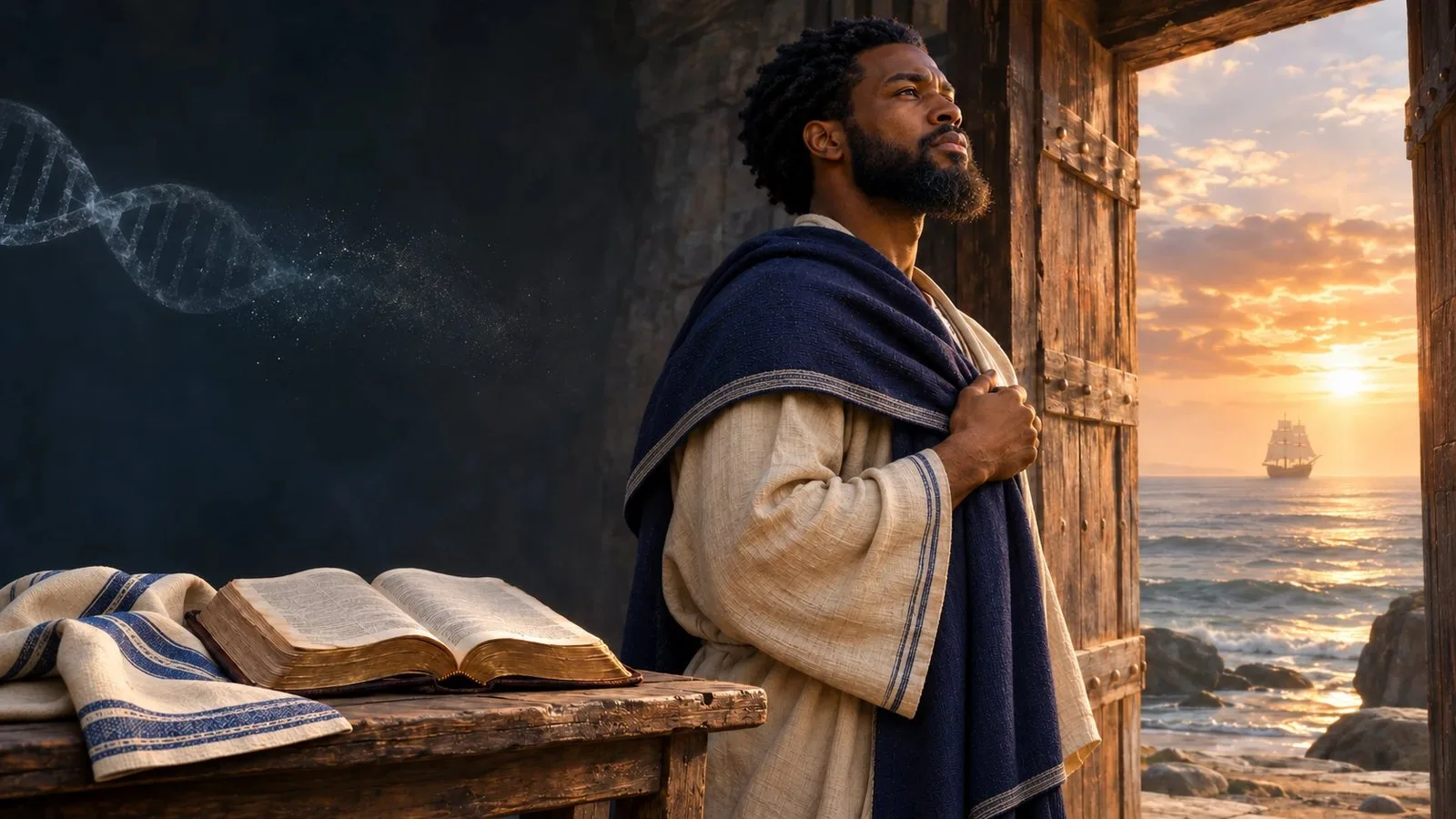
“And the LORD shall bring thee into Egypt again with ships, by the way whereof I spake unto thee, Thou shalt see it no more again: and there ye shall be sold unto your enemies for bondmen and bondwomen, and no man shall buy you” (Deuteronomy 28:68)
Consider the elements. Egypt again, Egypt being, in the scripture, the house of bondage: “I am the LORD thy God, which have brought thee out of the land of Egypt, out of the house of bondage” (Exodus 20:2). Not a return to the first land, but a return to its condition, in another land. With ships, the first deliverance was on foot, through the parted sea; this captivity would come by vessel. Sold unto your enemies for bondmen and bondwomen, human merchandise, in the hands of adversaries. And yet the verse ends, “and no man shall buy you.” Men did buy and sell the captives; the markets are a matter of record. But a sale among men could not transfer what belonged to God. Israel was the LORD’s before any enemy set a price on them, and remained the LORD’s throughout: they were sold, but they were never for sale, for no man can truly buy what belongs to the God of Israel.
See Psalm 74:1–2 and Isaiah 43.
Now ask the honest historical question: what nation on this earth, in all of recorded history, has gone through this? Taken by ships. Sold to enemies. Made bondmen and bondwomen. Carried into a new Egypt.
There is one answer, and it is not a matter of opinion. The transatlantic slave trade is the materialisation of this prophecy, the only event in recorded history that bears its complete signature. DNA cannot dispute it. Man’s history, whatever it wishes to be, cannot dispute it. The prophecy said ships, and the ships came. The prophecy said bondage again, and bondage came again. That is proof, and it stands regardless of what any laboratory reports.
The so-called slaves, sold by Africans and Mohammedans, who were part of the transatlantic slave trade, are the true Israelites. They are the only claimants. The prophecy belongs to them because the suffering belongs to them, and no other nation on earth has endured what they endured and survived all of it.
Routes, Not Roots
The same chapter declares the scattering: “And the LORD shall scatter thee among all people, from the one end of the earth even unto the other” (Deuteronomy 28:64). Over the centuries, the scattered of Israel moved into all corners of the earth. Even after slavery, they moved along the southern rim of Europe, across the northern rim of Africa, as far as India and possibly China, and they were certainly in and around West Africa again.
But here the common error enters quietly. The people taken to the Americas were embarked from West Africa and Angola. That is documented. What is merely assumed is that West Africa was therefore their origin. A port of embarkation is not a place of origin. To confuse the two is to mistake the last chapter of a journey for the whole story.
The scattering was wide. The prophecy’s signature belongs to one people. Those who came aboard those ships, they are the claimants, and there are no others.
Some who are now claiming to be Israelites are the same ones whose forefathers sold us.
An Example of the Divided House
There is a passage in the New Testament that deserves to be read slowly. When Christ sent out the twelve, “he commanded them, saying, Go not into the way of the Gentiles, and into any city of the Samaritans enter ye not: But go rather to the lost sheep of the house of Israel” (Matthew 10:5–6).
The Samaritans were not strangers to Israel. Samaria had been the northern kingdom’s capital, and that kingdom had turned away from the God of Israel long before its fall. They were of the northern kingdom, Israelites of the north, dwelling in the land after the kingdoms divided and after the Assyrian captivity carried the ten tribes away. Yet here is Christ Himself drawing a line: not to the Samaritans, but to the lost sheep of the house of Israel. Even He distinguished the difference.
The division of the kingdoms had consequences that echo through the whole story. Some of those scattered from the north were in time gathered in: the Samaritan woman at the well heard and believed, and many of her city with her (John 4:39); Philip later preached Christ in Samaria, and there was great joy in that city (Acts 8:5, 8). Individuals were added. But many were cut off. The instruction stands as a permanent caution: proximity to the name is not possession of the thing. Not everyone standing near Israel is of Israel, which is precisely what Romans 9:6 says. The caution must be read exactly, however: it is aimed at claiming by nearness, not at the stranger who turns.
Remember, our father Moses introduced them to the God of Israel, our true and living God; yet these same Israelites, along with strangers, built a calf, claiming that this golden image that Aaron made was their god. Just think about this for a moment: why was that call made, “Who is on the LORD’s side?”, and what happened to the other side? A great division, a separation (Exodus 32:26–33).
The door stands open to the earnest seeker from any nation: Cornelius, the centurion who feared God and prayed and gave alms, was heard, and Peter concluded that “in every nation he that feareth him, and worketh righteousness, is accepted with him” (Acts 10:2, 34–35).
Circumcision and the proper baptism are very important, along with the keeping of the new moon and the Sabbath together as one family, according to the scriptures.
The New Egypt
“Into Egypt again.” The word again does a great deal of work in that verse. Israel had been in bondage before and had been brought out. The prophecy speaks of a return to the condition: a new Egypt, a new house of bondage, reached this time by ships.
The scripture confirms elsewhere that Egypt can be a spiritual designation. Of the great city it is written that it “spiritually is called Sodom and Egypt, where also our Lord was crucified” (Revelation 11:8). A people can face the condition of suffering as it was in Egypt without being in that land. The lands of the Americas were not known when the scripture was written, and the people who first heard the prophecy would not have understood a name for them, so it speaks in the designation they knew: Egypt, again. Let this be explicit. The first Egypt was a land, a physical place, and the bondage there was also physical. The second Egypt is a physical land also, a real land across the sea; it is spiritual in its nature and its name, because the very same condition that made the first Egypt was repeated.
Egypt has been repeated again.
We are, by this reading, in the new Egypt now. This is why the modern scramble for the name of Israel is a serious matter rather than a curiosity. If the prophecy placed us here, then the question is not who can produce the most persuasive ancestry chart. The question is what the prophecy requires of those it describes.
Not the Present-Day Paint on the Doorpost
Consider what people reach for when they want to prove they are Israel. Sometimes it is the bloodline. Sometimes it is the customs: they mark the doorposts, they dress up in the colours and do other things in total ignorance, and then they claim to be Israel.
The doorposts matter.
On the night of the Passover, Israel was commanded: “they shall take of the blood, and strike it on the two side posts and on the upper door post of the houses, wherein they shall eat it” (Exodus 12:7). And the promise: “when I see the blood, I will pass over you” (Exodus 12:13). That was then. Why are you doing it now? Are you going into the wilderness afterwards?
Circumcision matters most:
11 And ye shall circumcise the flesh of your foreskin; and it shall be a token of the covenant betwixt me and you.
12 And he that is eight days old shall be circumcised among you, every man child in your generations, he that is born in the house, or bought with money of any stranger, which is not of thy seed.
13 He that is born in thy house, and he that is bought with thy money, must needs be circumcised: and my covenant shall be in your flesh for an everlasting covenant.
14 And the uncircumcised man child whose flesh of his foreskin is not circumcised, that soul shall be cut off from his people; he hath broken my covenant.
(Genesis 17:11–14)
A token, a sign, of the covenant. Not the covenant itself.
This is the distinction the claimants keep missing. Paint on a doorpost, without the covenant it signifies, is just decoration. Circumcision of the flesh, without the circumcision of the heart, is just surgery.
And the list does not end there. Consider the other things people reach for.
The fringes matter. Israel was commanded: “bid them that they make them fringes in the borders of their garments throughout their generations, and that they put upon the fringe of the borders a ribband of blue... that ye may look upon it, and remember all the commandments of the LORD, and do them” (Numbers 15:38–39). It must be said, however, that most who wear fringes today do not understand how the commandment applies. Which only sharpens the point: a fringe worn without understanding and incorrectly, without remembrance, without doing, is embroidery, and nothing more.
The dietary laws matter. “To make a difference between the unclean and the clean, and between the beast that may be eaten and the beast that may not be eaten” (Leviticus 11:47). Yet most who claim to keep them keep them wrongly, and a law kept wrongly is not kept at all. Clean meats on the table, without the understanding the law requires, are a menu.
The very name matters most of all, which is why it is the most dangerous thing to reach for. The name Israelite, worn as an identity without the covenant it signifies, is a modern-day costume.
The scripture is explicit about which one carries the weight: “And the LORD thy God will circumcise thine heart, and the heart of thy seed, to love the LORD thy God with all thine heart, and with all thy soul, that thou mayest live” (Deuteronomy 30:6).
And again: “Circumcise yourselves to the LORD, and take away the foreskins of your heart” (Jeremiah 4:4).
DNA may point to a lineage, but it cannot keep a covenant. Customs may preserve a memory, but paint on a doorpost can never save anyone who does not understand what the blood was for at the time it was introduced.
There is a connection between God and His people, and it is not genetic and it is not theatrical. It is covenantal: the laws, the statutes, and the commandments, kept, not performed, kept.
The Covenant Is the Content
This is what the claimants of the pie do not want to hear. A pie can be divided. A covenant cannot. You cannot take a slice of it the way you take a slice of a pie; you can only enter into the whole of it, on its terms.
Its terms are obedience. The same Deuteronomy that pronounces the curses opens with the condition, and the condition never changed. Israel is defined, in the scripture, not by who can prove descent, but by who will keep the law. The blood may carry the lineage, but only the covenant carries the life.
This is why the remnant does not mean everybody. The scripture speaks of “the remnant of Israel, and such as are escaped of the house of Jacob,” who “shall stay upon the LORD, the Holy One of Israel, in truth” (Isaiah 10:20).
A remnant is, by definition, not the whole. When everyone reaches for the name at once, the scripture’s own arithmetic should give pause: the remnant was never the crowd. There was only a very small crowd.
This is not a manner of speaking. Isaiah states the size itself, in the scripture’s own words: “Except the LORD of hosts had left unto us a very small remnant, we should have been as Sodom, and we should have been like unto Gomorrah” (Isaiah 1:9).
A very small remnant. Isaiah returns to it in the same terms: “For though thy people Israel be as the sand of the sea, yet a remnant of them shall return: the consumption decreed shall overflow with righteousness” (Isaiah 10:22). Paul, citing Isaiah, carries the identical arithmetic into the New Testament: “Esaias also crieth concerning Israel, Though the number of the children of Israel be as the sand of the sea, a remnant shall be saved” (Romans 9:27). Sand of the sea on one side; a remnant, a very small crowd, on the other. That is the proportion the scripture gives, and no later enthusiasm can enlarge it.
Nor does descent alone carry the name, even within the remnant. The word was given to Israel first, “It was necessary that the word of God should first have been spoken to you” (Acts 13:46), but the first hearing is not the same as acceptance.
A child of Jacob who has not claimed the inheritance and has not returned home is, in the teaching of this ministry, a Jacobite: of Jacob by descent, not yet Israel in standing. Jacob is the name of the descent. Israel is the name of the return, of the inheritance claimed and the covenant practised.
The Door Stands Open
Here is what confounds both the exclusionists and the opportunists, and it must be stated precisely. The claim belongs to the remnant of the ships; that is settled by prophecy. But Israel as a way of life is open to all nations. Claiming is not joining, and the scripture distinguishes them.
The law itself opened the door: “And when a stranger shall sojourn with thee, and will keep the passover to the LORD, let all his males be circumcised, and then let him come near and keep it; and he shall be as one that is born in the land” (Exodus 12:48). Note the importance of circumcision. And the principle, stated without qualification: “One law shall be to him that is homeborn, and unto the stranger that sojourneth among you” (Exodus 12:49).
Isaiah says it more expansively still: “Also the sons of the stranger, that join themselves to the LORD, to serve him, and to love the name of the LORD, to be his servants, every one that keepeth the sabbath from polluting it, and taketh hold of my covenant; even them will I bring to my holy mountain” (Isaiah 56:6–7).
Note the conditions. They are not ethnic. They are covenantal: to join oneself to the LORD, to serve Him, to love His name, to keep the Sabbath, to take hold of the covenant. The door of Israel has always stood open, but it opens inward, onto the law, not outward onto a claim (see 1 Kings 8:41–43).
This is the work of the Israelite Nation World Wide Ministries: to hold that door open, and to teach what lies on the other side of it. Not a pie to be claimed. A way of life to be entered.
The world is full of men teaching from a Bible that does not belong to them, and very few of them understand what they are teaching. This is something I always say: it is like a man in China finding the Magna Carta and calling it the Peking Book of Kings, the charter of another people, taken up and renamed as his own. A law cannot be kept correctly by guesswork from outside. Correct keeping is learned where the book is understood, through the doors of the House of Israel, and whoever wants to know more must find a real Israelite, and ask.
What Remains
So what does it truly mean to be an Israelite?
It means to be part of the people described by prophecy, scattered from one end of the earth to the other, carried by ships into a new Egypt, and to understand that no laboratory and no history book can overturn what the prophecy has already proven. The ships came. The bondage came again. No nation in recorded history has endured what this people endured, and that endurance is the seal on the prophecy.
There is a saying: you missed the boat. Those who run to DNA kits and ancestry charts in search of proof have missed the boat, the boat that sailed centuries ago, carrying the true Israelites into Egypt again. And remember: there was always only a small remnant, “a very small remnant” (Isaiah 1:9).
DNA is not enough. Customs and practices are not enough. The scattered people across the earth, who trace the routes of a prophecy fulfilled, are not all claimants; the claimants are those who came aboard the ships.
What remains is the covenant: the laws, the statutes, and the commandments, which must be kept from the soul inwardly and practised from the heart; the circumcision of the foreskin and of the heart, which must be done and completed; the connection between God and His people, kept in truth rather than claimed in appetite.
Israel is not a pie to be divided among claimants. It is a covenant to be kept by a remnant, to be one unique royal family in His kingdom; and the door, for all nations, stands open for you to enter and join that unique family.
Elder Shadrock Porter, Master Teacher of this royal family, put the matter plainly: “God does not make mistakes. So when everybody is claiming to be Israel, and they were not carried by ships into the new Egypt, there is a problem.”
Look again. Think deeply. Seek understanding.
— C. D. Ford